Inground Pool Removal in Mullica Hill, NJ
Harrison Township (Mullica Hill), Gloucester County. Family-owned, licensed and insured, and self-performing every stage of the work since 1979.
{{ NEEDS REAL DATA: typical price band for inground pool removal in Mullica Hill }} is the band for inground pool removal in Mullica Hill, NJ. Harrison Township properties range from village lots to former farmland subdivisions, and the soil and access differ sharply between them. J.A. Cuzzupe Inc. quotes each site individually and self-performs the whole job.
Free written estimates. Licensed and insured. Every site is quoted individually.
Request a quote for inground pool removal in Mullica Hill
Why this comes up in Mullica Hill.
Harrison Township is really two places, and pool removals here reflect that split. In the historic village the lots are older and tighter, the buildings are period and the access constraints resemble Haddonfield more than Gloucester County. Out on the former farmland — the subdivisions built from the 1990s onward off Mullica Hill Road and Route 322 — the lots are large, open and easy to work, and the pools are newer, which means removal is usually a lifestyle decision rather than a failure. Two local conditions matter. First, converted farmland often carries agricultural fill, plow pan and silty clay layers that behave differently under compaction than the sandy soil most of South Jersey sits on, so we pay closer attention to the backfill specification. Second, on the larger parcels there may still be old field drainage, wells or outbuilding foundations in the ground near the work area, and finding those with a bucket rather than a plan is how a straightforward job turns into a change order.
Housing stock
Mullica Hill is two things at once. The historic village along Main Street has 18th- and 19th-century buildings with stone foundations, tight frontages and original everything underground — work there is slow, careful and restoration-heavy. Outside the village, Harrison Township is farmland converted to large-lot residential over the last thirty years: newer homes on one- to five-acre parcels, long driveways, outbuildings, and a mix of public utilities in the developments and private septic and well on the older rural parcels. The newer stock rarely has pipe failures; the calls are about drainage across big lots, driveways, pads and pool work.
Ground conditions
This is old farm ground — silty loam topsoil over clay in much of the township, productive precisely because it holds moisture. That's excellent for tomatoes and poor for basements. Fields drain by way of swales and ditches that were cut decades ago for agriculture and have silted in as land was developed, so water now backs up where it used to run. The land rolls gently, which helps, but low points collect from a large catchment when a whole former field drains toward one new lot. Near the Raccoon Creek corridor the ground is lower and wetter, and wetland margins are a genuine constraint.
How the job runs in Mullica Hill.
- 01
Site visit to identify soil type, any agricultural fill or field drainage, and the equipment route from the road.
- 02
File the Harrison Township demolition permit and arrange the electrical and gas disconnects.
- 03
Locate the well and septic components on properties not served by public utilities before any digging.
- 04
Drain to an approved discharge point, clear of any well head or disposal field.
- 05
Demolish the shell and haul the concrete, steel and liner off to a licensed facility.
- 06
Backfill in compacted lifts with clean structural fill specified for the actual subsoil, not assumed sand.
- 07
Final grade for positive drainage, then topsoil and seed or restore to the surrounding cover.
What inground pool removal costs in Mullica Hill.
{{ NEEDS REAL DATA: typical price band for inground pool removal in Mullica Hill }}
That is a typical range, not a quote. Every site is different and every job is priced individually after we have walked it — in writing, with the scope itemized.
What moves the number in Mullica Hill
| Factor | Effect on price |
|---|---|
| Village lot vs. open subdivision lot | Historic-village access is tight and slow; a large open lot off Route 322 lets full-size equipment work efficiently. |
| Subsoil type on former farmland | Silty clay and plow pan compact differently from sand, which can change the fill specification and the effort to reach density. |
| Unknowns in the ground | Old field drainage, abandoned foundations or buried debris on converted farm parcels are discovered during the dig and priced as they arise. |
| Haul distance to disposal | Harrison Township is farther from disposal facilities than our Camden County work, and trucking time is a real cost. |
| Pool size, depth and construction | Volume and shell type drive both haul-out tonnage and the amount of fill to bring back in. |
| Well and septic protection | Routing equipment and discharge clear of a well head and disposal field can lengthen the working path. |
Permits in Harrison Township (Mullica Hill).
We file the permits and schedule the inspections ourselves — it isn’t left on your plate.
Harrison Township requires a demolition permit for inground pool removal with an electrical closeout. Properties in the historic village may carry additional review for anything visible from the street, and on well-and-septic parcels the discharge point and equipment route must stay clear of the well head and disposal field. {{ NEEDS REAL DATA: Harrison Township permit fee and application requirements for pool demolition, historic-village review where applicable, and well/septic setbacks }}
- Office
- Harrison Township Construction Department
- Phone
- (856) 478-4111
- Address
- 114 Bridgeton Pike, Mullica Hill, NJ 08062
- Hours
- Monday–Friday 8:00am–4:00pm
In-Ground Pool Demolition & Backfill
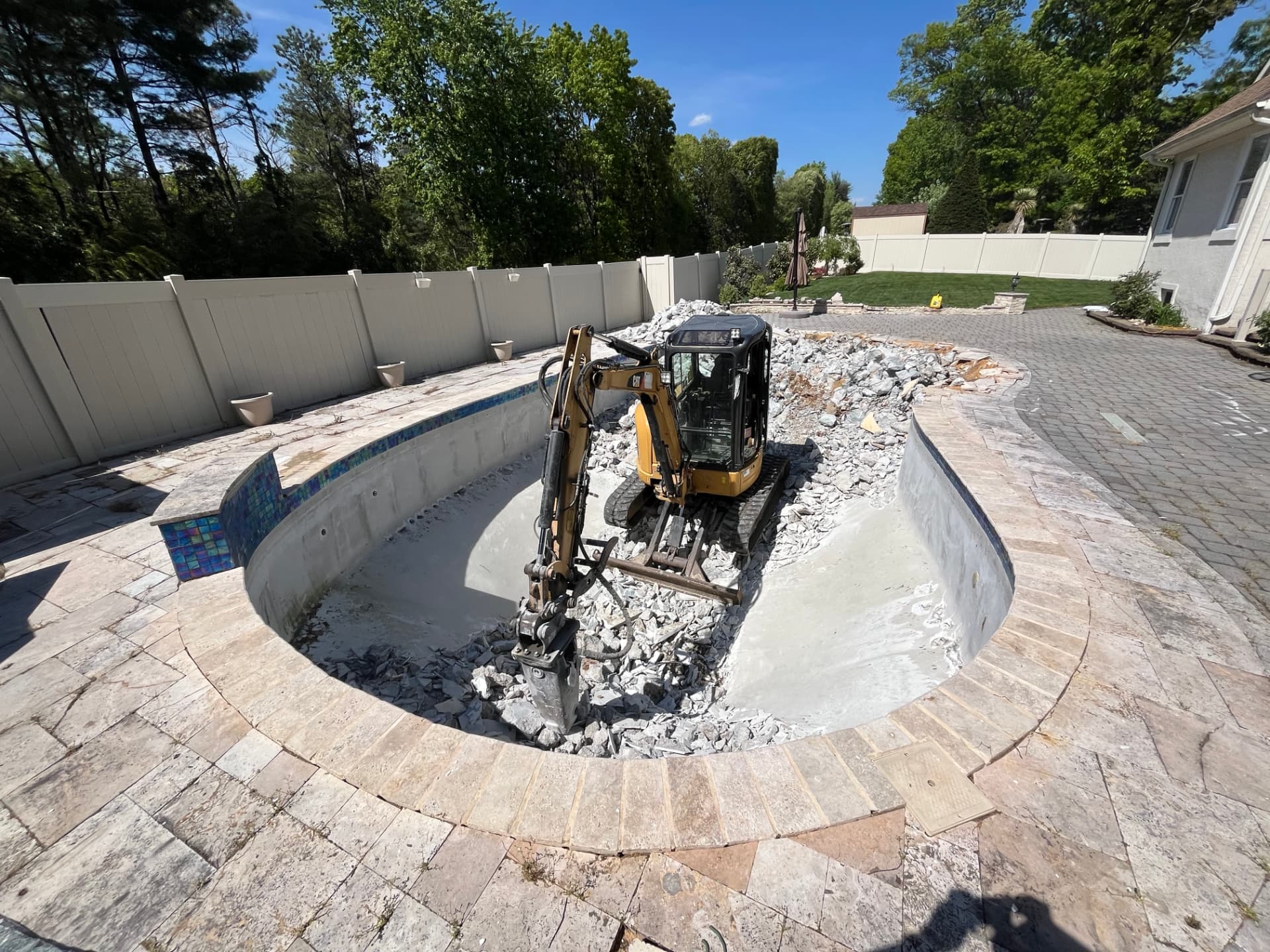
Removal of an in-ground gunite pool: shell broken out with a hydraulic hammer, debris hauled away, and the void backfilled and compacted in lifts — leaving a clean, buildable grade inside the existing paver patio.
Mullica Hill questions, answered.
It can. Farmland subsoils around Mullica Hill include silty clay layers and compacted plow pan that behave differently from the sand most of South Jersey sits on. Wet silt in particular is hard to compact and holds water. We look at what actually comes out of the hole and specify the fill accordingly rather than assuming clean sand and hoping it densifies.
On converted farm parcels it happens — old field tile, a buried foundation, a filled trench, occasionally dumped debris. We stop, show you what it is, and price the additional work before continuing. What we don't do is bury it back in the fill, because anything organic or voided under a compacted backfill becomes tomorrow's settlement.
It needs planning. Pool water gets discharged to an approved point well clear of the well head and, on septic properties, well clear of the disposal field. We locate both before the drain starts. Dumping tens of thousands of gallons in the wrong place on a well-and-septic lot can cause real trouble for the property.
That's a use question, not a condition one. A newer pool in good shape still costs money and time every season, and if nobody swims in it the calculus is the same as for an older one. Removal of a newer pool is generally more straightforward — sound structure, known construction, documented plumbing — and the yard comes back as full lawn.
Inground Pool Removal — Mullica Hill, NJ